How to Defeat a Skeptic
And Why It Matters Today

Cite this article
Landon Frim, “How to Defeat a Skeptic,’” June 27, 2026, https://www.landonfrim.org/how-to-defeat-a-skeptic/.
The most abstract questions in philosophy are often the most important. The timeless questions can be the most pressing. And of all the debates in philosophy, none is more abstract than: “Can we know anything at all?”
When philosophers talk about skepticism, they do not mean the simple disbelief in this or that claim. It is not just a healthy distrust in state propaganda, used car dealers, or folks selling supplements online. Nor is skepticism limited to the fringe, “do your own research” types – those with a decidedly unhealthy disbelief in vaccines or pasteurized milk. No, philosophical skepticism is far more global than all that. And for this reason, it is also more dangerous. Skepticism is the disbelief in knowledge itself. More accurately, it is the disbelief that we can ever be certain about any truth claims whatsoever.

On the face of it, that doesn't sound so threatening. Wouldn’t a mindless devotion to tradition be much worse? Isn’t a slavish embrace of prejudice and authority more pernicious than a stubborn disbelief in these things? Who is a more perilous neighbor: The fanatical true believer, willing to sacrifice anything (or anyone) to their cause, or the immovable soul, always suspicious of every grand claim and political project? It seems that a total rejection of knowledge transforms a person into a Socratic gadfly, a perma-critic, who is at most amusing (or at worst annoying) at parties, but not much else besides. The skeptic, then, is a professional contrarian and nonconformist. They are an eccentric free spirit; and as such, unlikely to be a terrorist or inquisitor, a death squad foot soldier or a concentration camp guard. So better to accept the skeptic than risk the fanatic.
But this is entirely wrong. In fact, skepticism counts among the most dangerous worldviews on offer today. Neither is it the polar opposite of fanaticism, as it might first seem. For precisely by denigrating knowledge as impossible, skepticism ushers people into a conventional mindset. Why question authority or tradition (especially at great personal risk or cost) when there are no certainly correct answers anyway? What point is there in uncovering falsity and injustice when no one can be certain about true justice to begin with? In a word, why not simply conform?
Two Species of Conformist
To be sure, this is not the conformity of the true believer. There are people who genuinely believe in “traditional values” with all their heart and soul. The true believer conforms as a matter of strong, inner conviction. They may believe that patriarchy is a virtue, that homosexuality and feminism are perverse vices, and that their supposedly eternal values are truly ordained by God and Nature. They may be wrong in their conformist beliefs, but at minimum, they readily admit to having beliefs in the first place. And when pressed, they may even admit to having underlying reasons for those convictions. Consequently, the conformist-true believer can, at least in principle, be reasoned with. One can question the truth of their premises, and challenge whether these premises actually lead to their political conclusions.

Not so with the conformist-skeptic. This figure is by nature smug, ironic, and self-satisfied. They do not pretend to have any special purchase on the truth. But then, they think, neither does anyone else. Their conformity is thus of the bulletproof variety. It is an aristocratic privilege whose imperious expression comes from being “above it all.” This kind of conformist does not feel the least bit anxiety when his “beliefs” are challenged; for he has no beliefs – not really. He thus feels no need to debate those energetic critics of the establishment. To him, such radicalism is merely an infantile disorder, born of the delusion that “the truth” exists and can really change the world. But he’s quite sure that it doesn’t, and it can’t.
To his impervious mind, there is no such Archimedean point called “The Truth” on which to stand; no privileged position from which one can leverage their reason to overturn established dogma. And since there is no such objective standpoint, everyone is equally mired in opinion and appearances. So maybe just relax. Accept appearances and custom for what they are; if not as verifiable truth, then at least as good enough norms for practical life. Yet in an era of rising fascism and xenophobia, of intensifying militarism and enforced patriarchy, “just relaxing” is the most dangerous thing one can do.
Ancient Roots
To be clear, this attitude is hardly modern. The ancient skeptics, at least going back to Sextus Empiricus and Pyrrho before him, had very much the same playbook. Their goal was likewise one of tranquility, a calming of the mind (what they called ataraxia). To this end, these ancient skeptics preached a doctrine of not knowing, and of rejecting certain knowledge.
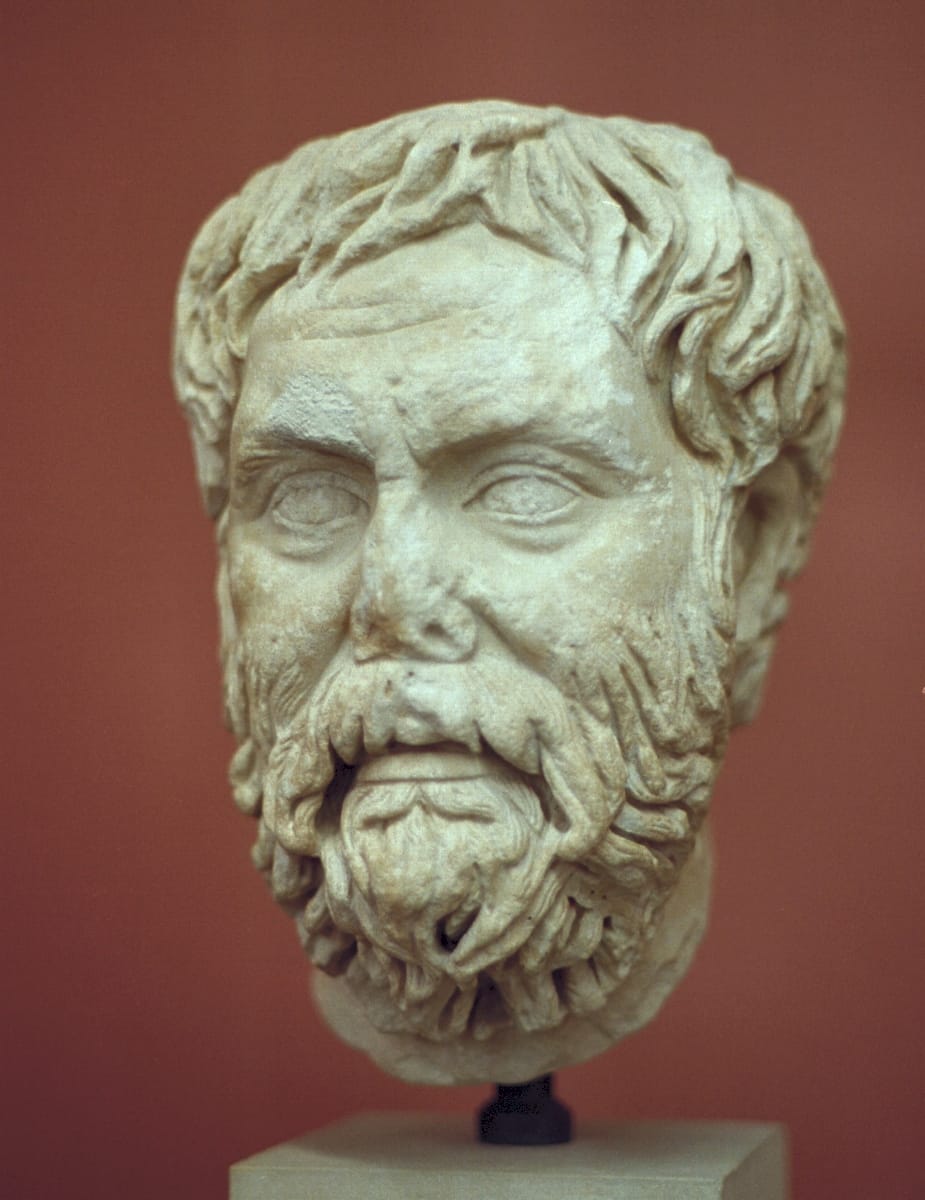
Predictably, the social consequence of not knowing was, very much like today, a kind of easygoing conformism. One cannot know anything for certain from the philosophical point of view, and so the operative phrase for these ancient skeptics was instead, “from an everyday point of view.” It is from an everyday point of view, proclaims Sextus, that one accepts “the handing down of customs and laws,” that “piety is good and impiety bad.”[1] We live and work, make laws and wage aggressive war, in real life, i.e., the domain of appearances and not certainty. In this way, the “everyday point of view” comes to dominate — not our philosophical convictions (which are, in any case, always dubious), but our real, practical life. Precisely because one is a hard-nosed skeptic in a philosophical debate, that same person is free to be an easygoing, ironical conservative in the domain of real politics. The skeptic thus has a free hand to profess traditional norms of the family, of obedience to social betters, and even of empire building, as at least seeming to be good. After all, these are the beliefs that readily garner applause from the people that matter. These are the respectable beliefs that get you paid. And, anyway, there is nothing better than seeming.
Hannah Arendt famously described Adolf Eichmann, the notorious Nazi war criminal, as having “never realized what he was doing.” Nonetheless, she writes, “he was not stupid. It was sheer thoughtlessness…that predisposed him to become one of the greatest criminals of that period.”[2] Certainly, Eichmann was no Sextus or Pyrrho. The philosophical skeptics were neither stupid nor thoughtless stooges like this Nazi thug. In fact, quite the opposite: they thought very deeply about all of the contrary arguments one might come up with for a given debate. It is the very “equipollence” (equal strength) of these contrary claims that finally allows one to have ataraxia of mind, which is to say, a calm disposition. You think so hard that, finally, you can shrug.

But then, the effect is the same after all. Once you recognize that the most intense thought only brings you to an impasse, then “thoughtlessness” seems the most natural response. In a world devoid of truth and final answers, why bother looking for these chimeras in the first place? Eichmann may not have been a philosophical skeptic, but his shallow acquiescence to custom and convention, his unthinking obedience to authority, his total lack of strong moral objection, is precisely the skeptical lifestyle.
If one wants to defeat this kind of easygoing, nonchalant authoritarianism, one must therefore defeat skepticism itself. For Reason (and rational politics) to win, philosophical skepticism must first be defeated.
How do we do this? As with any philosophical argument, one must clearly define the key terms. What is it, precisely, that the skeptic rejects? Well, it is “knowledge.” But here it is important to identify the specific meaning of “knowledge” that they reject. As a careful reader might already guess, the skeptic does not reject what only seems to be true. They do not reject claims of the type that “it seems to me to be raining.” Or, politically, that it seems virtuous to defend one’s country. Far from it. These are exactly the kinds of claims that the skeptic accepts, at least, “from the everyday point of view.”

No, what the skeptic rejects is knowledge in the sense of “a certainly true idea.” And so, if one wishes to defeat philosophical skepticism, then they must prove that some certainly true idea in fact exists within us. This is how one must define knowledge, that which skepticism rejects.
But how do we define skepticism itself? Here, one must call attention to a historical split when it comes to the meaning of that word. Without lapsing into obscure jargon, there have generally been two senses of the word skepticism. Each should be defeated in turn in order to overcome skepticism as a whole.
Dogmatic Skepticism
The first type of skepticism is what we might call “dogmatic” or absolute. Absolute skepticism makes a universal claim. “There is no knowledge.” Of course, it is fairly easy to guess what the objection to such a bold position might be. To claim that “I know that I know nothing” is an obvious self-contradiction. This is a statement that destroys itself. After all, one can always ask, do you know this to be true? If so, then you have just admitted to possessing at least one piece of knowledge.
Non-Dogmatic Skepticism
Far more threatening is non-dogmatic skepticism. This takes its cue from the ancient Greeks and Roman skeptics mentioned above, including Sextus Empiricus and Pyrrho (for which this kind of skepticism also has historically been called Pyrrhonian skepticism). Whatever the name, the basic idea is this: You can never be sure about what you know. This is a subtle but crucial difference. It is not the dogmatic, absolute, and therefore self-defeating claim that “I know that I know nothing.” Instead, what we have here is the subtler, and therefore far more threatening claim that, “I just don't know what I know for sure.” The goal is the aforementioned ataraxia, or relaxation of the mind. There is always a contrary impression, opinion, or argument which may overturn your presently held beliefs. You can never be sure of anything. So, again, just relax.
Yet non-dogmatic skepticism is really just a con. It only masquerades as more threatening — indeed, as at all different — from its dogmatic counterpart. In truth, it is just as self-defeating. The reason for this is simple enough, and hard to ignore once it's been said aloud once. One must only recall the definition of knowledge, precisely the kind of knowledge that the skeptic (of whatever sort) necessarily rejects: Knowledge is a “certainly true idea.”
The non-dogmatic skeptic thus makes the claim: “I am unsure whether I have any knowledge.” But, more precisely, the claim is rendered: “I am uncertain whether I am certain.” And just here we notice the fallacy of this position. For certainty is not some vague inner feeling, cut off from reflection. As Spinoza saw, certainty is reflexive. To be certain is already, in the act itself, to be certain that one is certain. There is no gap, in Spinoza’s favored example, between “knowing Peter” and also “knowing that you know Peter.”[3] If I am certain, then I am also certain that I am certain. Conversely, if I am certain that I am certain, then in the first place, I must have been certain.

This may seem an abstract point, and it is. But it is also critically important in defeating the supposedly non-dogmatic skeptic. For they can no longer claim an innocent “suspension of belief.” There is no more shoulder-shrugging, fence-sitting uncertainty as to whether one possesses some knowledge or not. Instead, an answer must be given one way or the other. An outright declaration has to be made. Because, if knowledge just means certainty, then being uncertain whether you have knowledge entails — simply — that one has no knowledge. Full stop.
This is why the supposedly “non-dogmatic” and the “dogmatic” skeptic are really alike. At the end of the day, each is saying the very same thing. There is no certainty; there is no knowledge. It is why they are equally self-refuting as well. Once more, it was Spinoza who distilled this point some 350 years ago. Criticizing the skeptic, he pointed out:
If they affirm or doubt something, they do not know that they affirm or doubt. They say they know nothing, and that they do not even know that they know nothing. And even this they do not say absolutely. For they are afraid to confess that they exist, so long as they know nothing. In the end, they must be speechless, lest by chance they assume something that might smell of truth…If they deny, grant, or oppose, they do not know that they deny, grant, or oppose. So they must be regarded as automata, completely lacking a mind.[4]

Put plainly, the skeptic (of whatever variety) isn't saying anything at all. They are, to use the contemporary philosophical expression, “barking like a dog.” To affirm that we possess some knowledge is to give up being a skeptic. That is plain enough. To deny the existence of all knowledge is a self-contradiction, because that itself is a knowledge claim. That too is clear. The only novel insight is this: To declare a suspension of judgment, to claim uncertainty about being certain, is equally a self-contradiction. The skeptic, whichever their pitch, must therefore remain silent. From this point, their derision of knowledge – and thus of rational criticism – can be passed over without anxiety or argument. It is mere barking.
The question, of course, still remains: If skepticism is wrong, then what can we know for sure? That is a topic for a future essay. But whatever this foundational knowledge amounts to should form the basis for our worldview and value system – not only our metaphysics, but our politics and ethics as well. At the very least, we can rest assured that this project of constructing a rational politics is not only of paramount importance; it is also achievable in real life.
FOOTNOTES
[1] Sextus Empiricus, Outlines of Scepticism, ed. Julia Annas and Jonathan Barnes (Oxford University Press, 2011), I.24.
[2] Hannah Arendt, Eichmann in Jerusalem: A Report on the Banality of Evil (The Viking Press, 1964), Postscript.
[3] Benedictus de Spinoza, “Treatise on the Emendation of the Intellect,” in The Collected Works of Spinoza, Volume I, ed. and trans. Edwin Curley (Princeton University Press, 1985), sec. 34.
[4] Spinoza, “Treatise on the Emendation of the Intellect,” sec. 47.